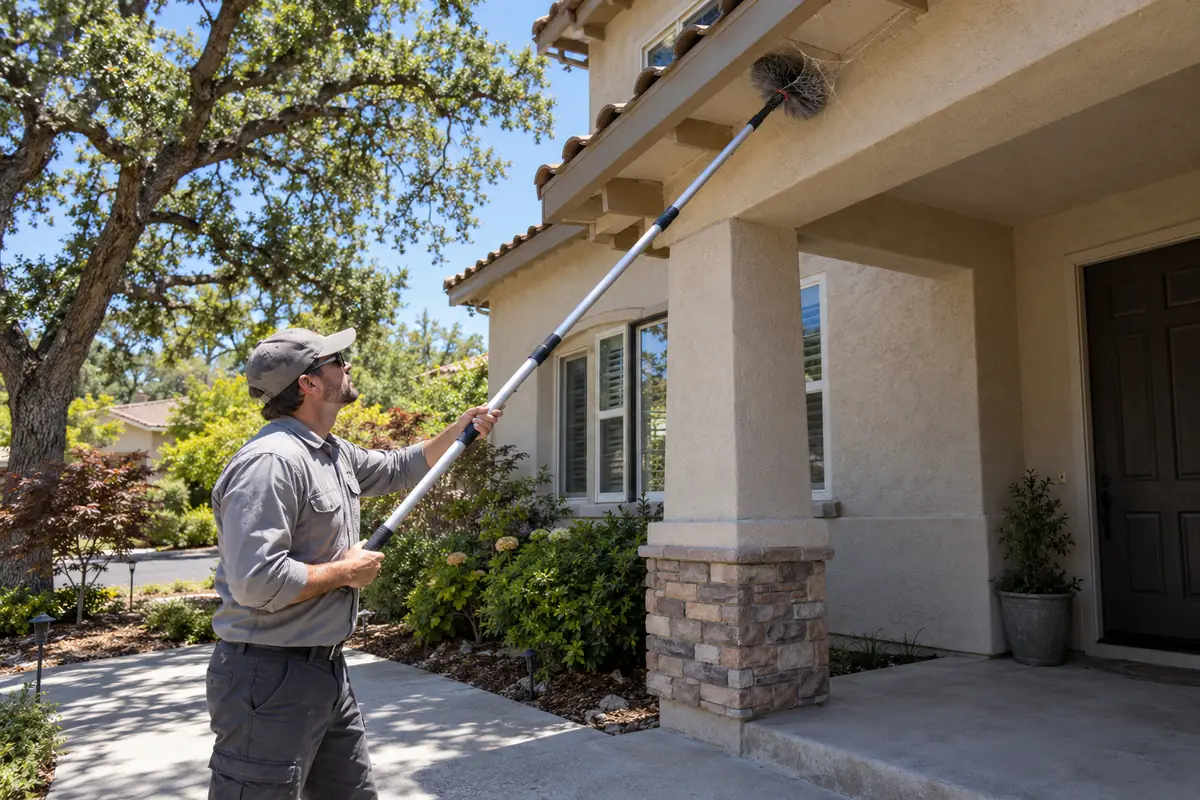
In San Diego, CA, spider control begins with sorting harmless web builders from the few species that deserve attention, and continues by cutting back the insects the spiders eat. Garages, sheds, window frames and woodpiles are where black widows, wolf spiders, cellar spiders, orb weavers and, in some regions, brown recluses tend to turn up. Use Call Now, describe what you found, and our team serving 76 ZIP codes around San Diego will answer.
Spiders worth knowing about
Black widow
This spider is glossy black with a red hourglass marking underneath. Cluttered, dark places that nobody disturbs, such as woodpiles, meter boxes and garages, are where it settles. Bites do not happen often, but when they do they matter medically.
Brown recluse
A violin-shaped dark mark on a light brown body, plus six eyes set in three pairs, identify it. It belongs to the central and southeastern states and is unusual elsewhere, and it hides away in boxes, closets and storage.
Wolf spiders and cellar spiders
Wolf spiders chase prey across the ground at speed and may roam into the house, while cellar spiders dangle from corners and basement ceilings on long thin legs. Generally speaking, both are harmless.
Spider bites and when to see a doctor
This site does not diagnose a bite or a skin mark. If you are bitten and feel severe pain, spreading redness, cramping, fever or trouble breathing, seek medical care at once, and bring the spider in a sealed container if you can safely capture it.
Put on gloves before you move boxes, firewood or garden tools, and give any shoes or gloves kept in the garage a good shake.
Why spiders move into homes
Spiders follow their food. A home with ants, flies, crickets and moths attracts spiders to hunt them. Clutter, boxes, stacked firewood, outdoor lighting that draws insects and gaps around doors and windows give shelter and entry.
Fewer insects and fewer hiding places do more to reduce spiders than spraying their webs ever will.
Keep spiders out of the house
- Keep firewood and debris away from the foundation
- Vacuum corners, window sills and the garage regularly
- Store items in sealed plastic bins instead of cardboard
- Reduce outdoor lighting at night near entrances
- Seal gaps around windows, doors, pipes and vents
How spider control is done
- Web and egg-sac removal by vacuum or brush
- Sealing gaps, installing door sweeps and replacing white outdoor bulbs with warm-toned bulbs
- Residual perimeter treatment around doors, windows and foundation
- Dust in voids and cracks where spiders hide
- Inspection of garages, eaves, attics, crawl spaces and window frames
How a spider control visit works, step by step
Whatever is bothering you, a sound pest visit moves through the same stages in the same sequence. Once you know that sequence, it is easy to line companies up against each other and to notice when one jumps past the inspection and identification stages.
- Inspection: the technician walks the outside first (foundation, vents, utility lines, eaves, fence lines, mulch) and then the inside (kitchen, bathrooms, garage, attic or crawl space).
- Identification: the species is named from the insect, droppings, damage or trail, because the right product and method depend on it.
- Plan: we explain what will be done, which products or devices will be used, and what you need to do before and after.
- Treatment or exclusion: the work is done in the places the inspection found, not by spraying every room.
- Follow-up: you get a date for the next check and a clear answer on what to report if activity returns.
Questions to ask before you agree to any spider control
- What will you write down for me: scope, exclusions, follow-up and product list?
- What will you seal, remove or fix, and what stays my job?
- What species or problem did you find, and what did you see that proves it?
- Which products, baits or devices will you use, and where will they go?
- Who is on site, and can you show the state licence or applicator ID for the work?
What changes the scope of the work
Two homes on the same street can need very different spider control plans. The written scope should say which of these factors applied to your property and what each one added or removed from the job.
Two things make proposals easier to compare: a clear line between a single treatment and ongoing service, and a note of anything the technician could not get to. Scopes that name the places you were worried about, such as the attic, crawl space, garage or fence line, beat a generic package every time.
- Access to attics, wall voids, sheds, outbuildings and the yard
- Size and age of the home, and whether it sits on a slab, a crawl space or a basement
- Whether you want a single treatment or an ongoing plan with scheduled visits
- Number of entry points, gaps around pipes and cracks in the foundation or siding
- How far the problem has spread and how long it has been active
What makes spider control different in San Diego
Mild year-round weather keeps pests active in all seasons. Argentine ants are a constant in San Diego yards and kitchens; drywood termites are a structural concern.
Roof rats use palms and canyon edges; Norway rats appear near restaurants and the waterfront. Urban canyons and hillsides give pests wildlife corridors close to homes. What works in one climate or housing style can fall flat in the next, so ask us to explain how these local details shape the plan for your property.
Spider control across San Diego and nearby cities
In San Diego, California, Pest Control San Diego serves 76 ZIP codes: 92101, 92102, 92103, 92104, 92105, 92106, 92107, 92108, 92109, 92110. We also serve Coronado, National City, Chula Vista, Lemon Grove and La Mesa. Each address is checked individually, which is why it helps to give your ZIP code on the call.
Use Call Now at the top of the page, describe what you found, and you will be put through to our team in the area. We check the address, inspect the property and give you the scope in writing.
Related help in San Diego
If this is not quite your situation, these pages cover the neighboring questions: How to Choose a Pest Control Company; How Pests Get Into San Diego Homes: Entry Points and Fixes; Signs of Rats vs Mice; Mosquito Control. The service area list shows every nearby city and ZIP code covered.
Spider Control in San Diego: common questions
How often should spider control be done?
For many homes, perimeter treatments timed by season, with the emphasis on spring and fall, are enough. Heavy spider pressure can call for visits more often.
Are brown recluse spiders in my area?
Parts of the central and southeastern United States are the native range of brown recluses, and they are uncommon in many other regions. Plenty of spiders that get called recluses are a different, harmless species. We can identify a specimen for you.
Do spiders mean I have a bug problem?
Quite often. A steady spider population usually means there are ants, flies, roaches or moths for them to hunt, and controlling that prey reduces the spiders too.
How can I tell if a spider is dangerous?
Recalling the markings (a red hourglass on a black widow, a violin shape and six eyes on a brown recluse) is not a reliable way to identify a spider. Unsure? Photograph it without touching it and get a professional's opinion.
Should I remove spider webs?
Do it often. Getting rid of webs and egg sacs heads off the next generation and shows you the places spiders return to.
Does spraying kill spiders?
A residual perimeter treatment cuts down the spiders that cross the treated area, though species that never walk on the treated surface can be missed. Clearing webs and sealing entries adds to the effect.
Continue with the next useful question